
What Tribe Are We From?
- rqmoralez
- Oct 19, 2025
- 4 min read
Updated: Oct 19, 2025
Discovering your Mexican ancestry can be a tall order. It takes time, effort and patience along with a good plan to be able to effectively get results. Birth, marriage and death records usually form the foundation of your family tree so most people spend their time searching and putting those pieces together, making sure that each person being added belongs. Granted, you need this information, but what about those other questions that come to mind as you explore your past? What were the living conditions? What did they eat and where did they get fresh water? What did they do for work? What made them happy? What terrified them? So many questions!
Well, one of those "burning" questions I often get from within my family is "What Tribe Are We From?" It's a question that I assume comes up often at family gatherings or family reunions. Most of us with Mexican ancestry know that we have native American roots, so how can we find some answers? First, we need to take a step back and look at the history of this area to understand what was already there long before any Europeans arrived.
Start by looking at the map below and taking note of the various Tribes and the general areas that they occupied. These were some of the major Tribes in this specific region, but there were many others scattered throughout. Also, keep in mind that 500 years ago these were areas with no international boundaries, but rather just open territory dotted with indigenous groups of people. Most were smaller Tribes that lived within confined geographic areas and rarely had to venture away, as they had found resources to sustain themselves within their localized area. Others were more nomadic in nature and traveled large distances in order to survive, usually a result of limited resources in their area or a need to expand their territory or both. Some groups lived in environments that were lush with vegetation, fertile soil and plenty of fresh water. Others lived in the harsh climates of today's northern Mexico and the southwestern U.S. but found ways to make use of the sunny days, rivers and streams to keep food and water available. In any case, many of these groups had been settled for hundreds, if not thousands, of years and had found ways to survive in their part of the world... that is, until the Spanish and other Europeans began to arrive in the early 1500's.

Over the next few centuries, the Spanish would arrive by the tens of thousands, mostly through the port at Vera Cruz, many of them single men, in search of a better life.

As many Spaniards made their way northward into Nueva Vizcaya over the decades, they would encounter the different Native American Tribes and would eventually begin blending together in life and blood. The result is some of what we see recorded in the Catholic church records and other documentation today.
Now, let's get back to the original question: "What Tribe Are We From?" Well, those of you that have gone deep in your family research have probably already seen the records or read the some of the literature indicating the Spanish lived in close proximity to the indigenous people almost from the start. You also know that the many of early Europeans (mostly Spanish) to arrive were single men, many of whom left the poverty of their homeland. Given that, one can only assume that interracial marriages were inevitable as long as they were allowed by the church, which they were, and today the records are there to be found.
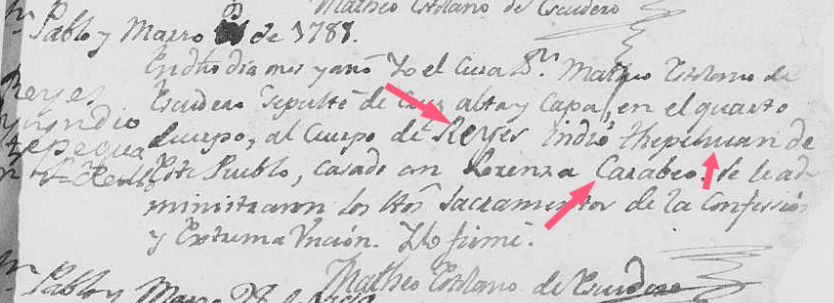
For those of you that are just starting to discover your Mexican ancestry, the only real way to find answers is to begin by tracing your own lineage back as far as you are able and hope that the church records and other documentation, provide you with some of the answers you seek. The good news... if you go back far enough, there is a strong likelihood that you will be able to locate some of your ancestors that were of indigenous origin by the use of terms like "mestizo" meaning "mixed" and "Yndia" indicating indigenous. Below are a few of the many records I have located that provide some real answers to the "burning question".

Now for the bad news.....unless you are one of the lucky few, as noted in the examples above, the answers may prove elusive. That's because many of the church records, at least in my research, do not specify a particular indigenous group. More often than not the records will look more like the one below which records the "Yndio" but stops there. Granted, this is still a terrific record but note that it did not give us the Tribe to which Juan Baptista Griego was associated. In my experience, this is more the norm. At this point, the best recourse may be to make assumptions about Tribe based on the map above and the location of the record.

Conclusion: Even though there are numerous entries throughout the Catholic church records indicating marriage between Europeans (mostly Spanish) and "Yndios", most entries do not indicate the specific indigenous group. If you happen to find one, and you can link your family lineage to that person, consider yourself lucky. Unfortunately for most people of Mexican ancestry, this will be one of the questions for which there may never be a specific answer. For most of us, it is probably safe to say that the indigenous part of our Mexican ancestry descends from a combination of the various indigenous groups that dotted the region. Being able to identify when and where your line of ancestors lived and placing that information against the backdrop of the map above will give you a better sense for what that mix probably looks like.
If you have ancestors that lived in Nueva Vizcaya (state of Chihuahua with parts of the surrounding states), I probably already have much of the information to get you started. Reach me at contact@texmexgenealogy.com and we can talk about a plan. Good luck!


Comments